· 7 min read
How to Fix Slop
cultural-thread

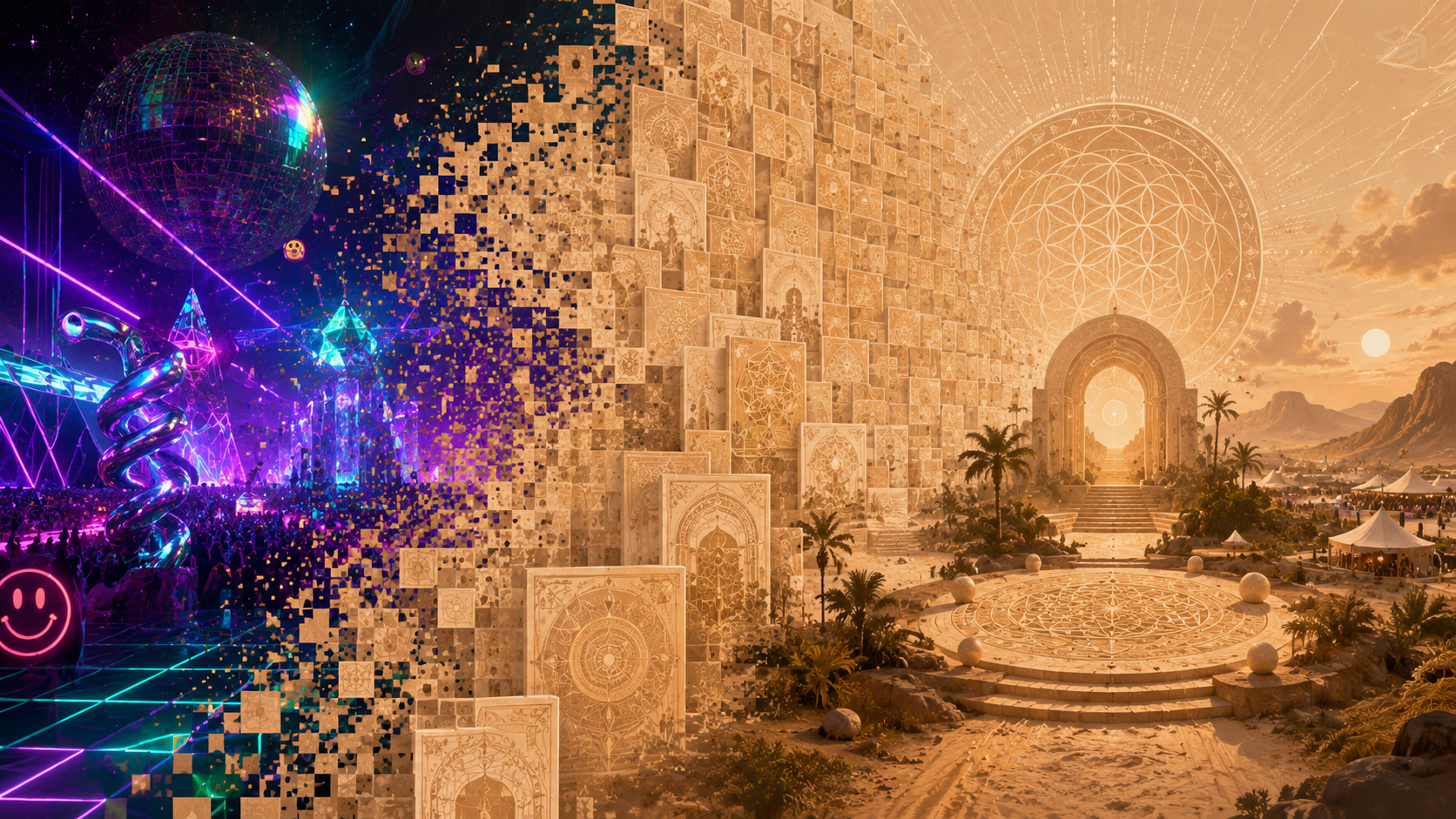
The festival and retreat scene set one default picture of the word psychedelic, and AI tools learned to repeat it. A companion to Against Slop.
There is a default picture of the word “psychedelic,” and lately that picture is beige.
Warm earth tones. A mandala. Sacred geometry. A serene figure. Maybe a jungle. Maybe mushrooms. Maybe an eye floating somewhere it does not need to be. Type the word into an image model and some version of that comes back.
That look did not fall out of the sky. It is not the only psychedelic look, and it is not what psychedelic art looked like for most of its history. It became the default because one part of the culture kept producing a consistent visual language while almost everything else fractured into smaller scenes. Then AI tools learned from the visible average and started repeating it back at industrial scale.
This is not a complaint about people who use psychedelic spaces for healing. Some people get real help from retreats, ceremonies, yoga, meditation, festivals, recovery work, therapy culture, or whatever combination gets them through life. That is not my argument.
This is an aesthetic observation.
At some point, the most visible version of psychedelia became tied to a specific spiritual-wellness image kit. The kit is not fake. It comes from real communities, real artists, real experiences, and real beliefs. But it is still a kit. Once it becomes the default, the word “psychedelic” stops pointing at a giant field of visual possibilities and starts pointing at one narrow lane.
Roughly the same drugs have passed through very different cultures, and each culture drew the experience in its own way.
One picture comes from the transformational festival and retreat world: earthy, communal, inward-facing, spiritual, body-centered, often filtered through yoga, plant medicine, meditation, sustainability, and workshop culture. Its visual language is warm and organic. Mandalas. Sacred geometry. Sunrises. Jungle plants. Serene faces. Handmade textures. The feeling is less “blast through hyperspace” and more “return to the earth with better breathing.”
Another picture comes from rave, club, and electronic music culture, especially from the 80s through the 2000s. Same drugs, often the same night, sometimes the same people, but a totally different image system. Neon. Lasers. Synthetic color. Acid-house smileys. Chrome. Robots. Video-game palettes. Space tunnels. Futuristic typography. Black rooms with impossible light in them. Cold where the other is warm. Built where the other is grown.
Neither one is the true face of psychedelia, because there is no true face. Psychedelia is an experience filtered through whoever is interpreting it. The interesting part is how one picture became the default while the other stayed more scattered.
The old monoculture is gone. The machines that made “the 60s look” or “the 80s look” do not work the same way anymore. Three networks, MTV, mall movies, newsstand magazines, record stores, regional flyers, those systems once pushed the same images through millions of people. That world broke apart.
The beige psychedelic default is one of the exceptions. It spread because the festival and retreat ecosystem still had something close to a distribution machine.
The transformational festival circuit had stages, booths, galleries, live painters, yoga spaces, lecture tents, workshop programming, vendors, photographers, recap videos, and social feeds. It was not just a crowd. It was an image-production system. A painter could make the work in public, hang it on site, sell prints, appear in the festival recap, get reposted by attendees, show up in someone’s retreat memory, then return the next season with more of the same visual language.
That matters. Aesthetic defaults do not win because they are correct. They win because they repeat.
The rave side had its own visual history, but it did not build the same kind of lasting gallery-and-wellness machine. It had flyers, record sleeves, club lighting, VJ loops, fashion, warehouse photos, websites, DVD menus, and scattered archives. A lot of it was disposable by design. The flyer got wet. The site vanished. The club closed. The hard drive died. The scene moved on.
So the warm, spiritual, festival-retreat image kept accumulating. The cold, synthetic, rave image left fragments.
That does not make one better. It explains why one became easier for machines and casual audiences to recognize.
The plant-medicine boom intensified the pattern. As ayahuasca retreats became more visible to Western audiences, a specific image set moved with them: jungle plants, healers, serpents, jaguars, cosmic vines, geometric visions, ceremonial objects, earth palettes, and spiritual transformation language.
Again, this is not a verdict on the practice. It is a note about visual transmission.
A retreat experience becomes a story. The story becomes a painting. The painting becomes a print. The print becomes a festival booth. The booth becomes an Instagram post. The post becomes training data. Then a model learns that this is what “psychedelic” means.
That last step is where the slop problem starts.
An image model does not know what psychedelia is. It knows what images have been associated with the word.
If enough online images tagged or described as psychedelic contain sacred geometry, mushrooms, eyes, mandalas, glowing chakras, cosmic faces, and warm festival colors, the model will return those things. Not because it has an opinion. Not because it understands the experience. Because that is the statistical pile attached to the word.
Then the loop tightens.
A million people type “psychedelic poster.” The model gives them mushrooms and eyes. They post the result. The next model sees even more mushrooms and eyes. The default gets narrower. The image gets smoother. The original reasons fall away. What remains is the residue of the residue.
That is slop.
Not because the source culture was bad. Not because AI is automatically bad. Slop is what happens when the average becomes the method.
The answer is not to hate the beige. Plenty of that work is beautiful. Plenty of it was made by real artists with real skill, real belief, and real experience behind it.
The answer is to remember that it is one encoding.
Psychedelic art had visual languages before the retreat scene became the most visible container for the word. The 1960s concert posters were not built from the current icon kit. They were liquid typography, Art Nouveau revival, Vienna Secession lettering, warped advertising language, and color theory pushed until the page vibrated. The letters mattered as much as the symbols. The colors were not “trippy” because someone added a mushroom. They were trippy because the design physically fought your eyes.
Before that, there were trick films, surrealist objects, kaleidoscope dance numbers, optical toys, science-fiction covers, spiritualist photography, stage magic, animation, experimental cinema, and nightclub lighting. Psychedelia did not begin as a beige mandala. It became one because a particular scene made that image visible at scale.
And that is the useful part.
Once you see the default as an encoding, you can stop treating it like a law. You can go back into the residue and choose better ingredients. You can decide whether your psychedelia is botanical, synthetic, gothic, cinematic, comic, occult, industrial, oceanic, theatrical, candy-colored, radioactive, chrome-plated, or something with no clean name yet.
That is where style begins.
The common version is one picture. The history behind it holds thousands.
The mistake is not making spiritual psychedelic art. The mistake is assuming spiritual psychedelic art is what the word means. The mistake is typing “psychedelic” and letting the machine choose the archive for you.
A style starts when you choose the archive yourself.
The rules for not settling are here: Against Slop. One style built from them is here: Psychedelic Goth: A Definition.