· 6 min read
A False Recipe, a Real Image
grimoire

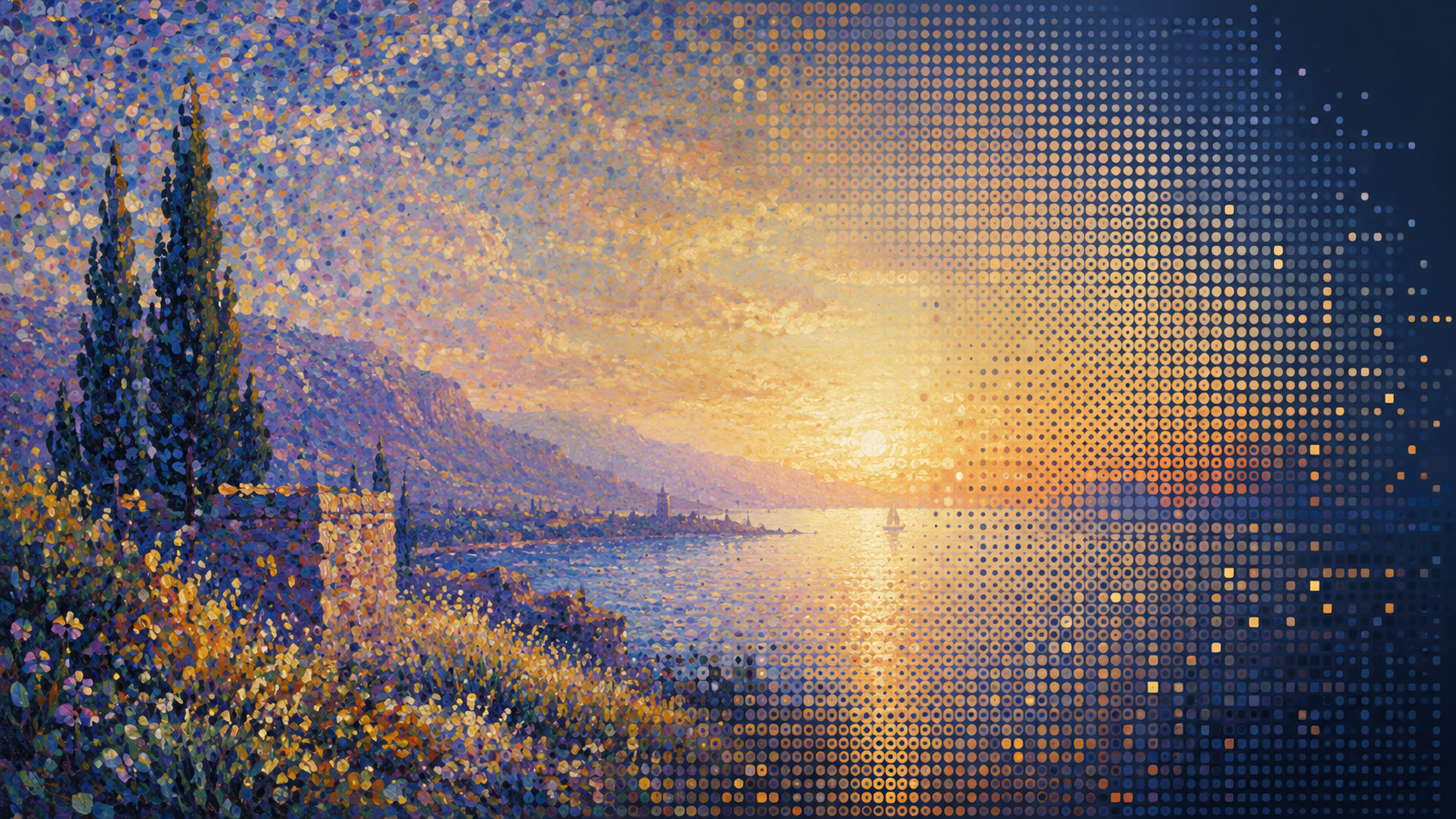
A forgotten nineteenth-century painting method still has something to teach digital image systems: separate the parts, structure the surface, and let the image resolve.
Divisionism sounds like the kind of art-history term that gets trapped in a museum label and never escapes.
Dots. Strokes. Seurat. Pointillism. Something French. Something old.
That is the boring version.
The useful version is stranger: about 150 years ago, painters were already treating images like systems made from separated units. They were not blending everything into smooth mush. They were breaking color apart, placing those parts next to each other, and trusting the viewer’s eye to finish the job.
That makes Divisionism feel less like a dead painting style and more like a pre-digital rendering idea.
Up close, the image is broken.
Step back, and it resolves.
Divisionism is often flattened into Pointillism, but they are not exactly the same thing.
Pointillism is the dot method: little marks placed across the canvas until they form an image.
Divisionism is the larger idea underneath it: separating color into individual marks, dots, strokes, or patches so they interact visually instead of being fully mixed on the palette.
That difference matters.
The dot is only one possible interface.
The real trick is division.
Instead of saying, “Mix the color first, then paint the object,” Divisionism says something closer to: “Separate the ingredients, arrange them carefully, and let perception do part of the blending.”
That is not just a painting technique. That is a visual system.
A Divisionist painting has two states.
From nearby, it is a field of marks. Dots, dashes, small strokes, patches of color. The surface does not hide how it was made.
From farther away, those marks collapse into light, shadow, atmosphere, skin, water, trees, clothing, distance, and air.
The viewer is not passive. The viewer completes the image.
That is the part that still feels modern.
A screen does the same thing in a different medium. Pixels are separate units until distance and resolution turn them into a face, a landscape, a menu, a video, a joke, a bad ad, or whatever else the machine is throwing at us today.
A printed halftone image does it with dots.
Dithering does it with limited colors arranged into a convincing illusion.
Compression does it with blocks and approximations.
A shader does it through rules that produce surface and light.
Divisionism belongs to that family of ideas.
Not because it was digital. It was not.
Because it understood that an image can be built from structured parts that only become whole through a viewing system.
The Divisionists believed they were working from scientific color theory. They were reading the color science available to them and trying to make painting more methodical, less dependent on instinct.
Some of those beliefs are more complicated than the artists thought.
Pigment is not light. Mixing colored light is not the same as mixing paint. A field of separated pigments does not magically produce every luminosity the theory promised.
But that does not make the work uninteresting.
Sometimes the useful thing is not that a theory is perfectly correct. It is that the theory forces a new method.
Divisionism made artists stop treating the painted surface as a place where color had to be smoothed over and hidden. It made the surface visible as a system.
That is why it still matters.
Even when the science was imperfect, the workflow was powerful.
Separate the parts.
Control the relationships.
Let perception resolve the image.
Most people using image systems today still talk in blobs.
Aesthetic. Vibe. Style. Mood. Cinematic. Psychedelic. Futuristic. Weird.
Those words are not useless, but they collapse too much. They ask the machine to guess which parts matter.
Divisionism points in the opposite direction.
Do not start with the mush.
Start with the units.
What is the mark? What is the color relationship? What repeats? What changes at distance? What does the viewer see first? What only appears after the image resolves? What is separate up close but unified from far away?
That is useful for painting. It is also useful for image generation, design systems, prompt writing, video, layout, metadata, and archives.
The lesson is not “make everything look like Seurat.”
The lesson is: build images from parts that know what job they have.
This is where Divisionism connects back to the Grimoire.
The Grimoire is not separating pigment. It is separating concepts.
Materials. Coverings. Subjects. Lighting. Motifs. Poses. Objects. Domains. Textures. Processes. Visual atoms.
A Divisionist painter might separate color so the eye can assemble light.
The Grimoire separates concepts so a system can assemble artifacts.
That is the bridge.
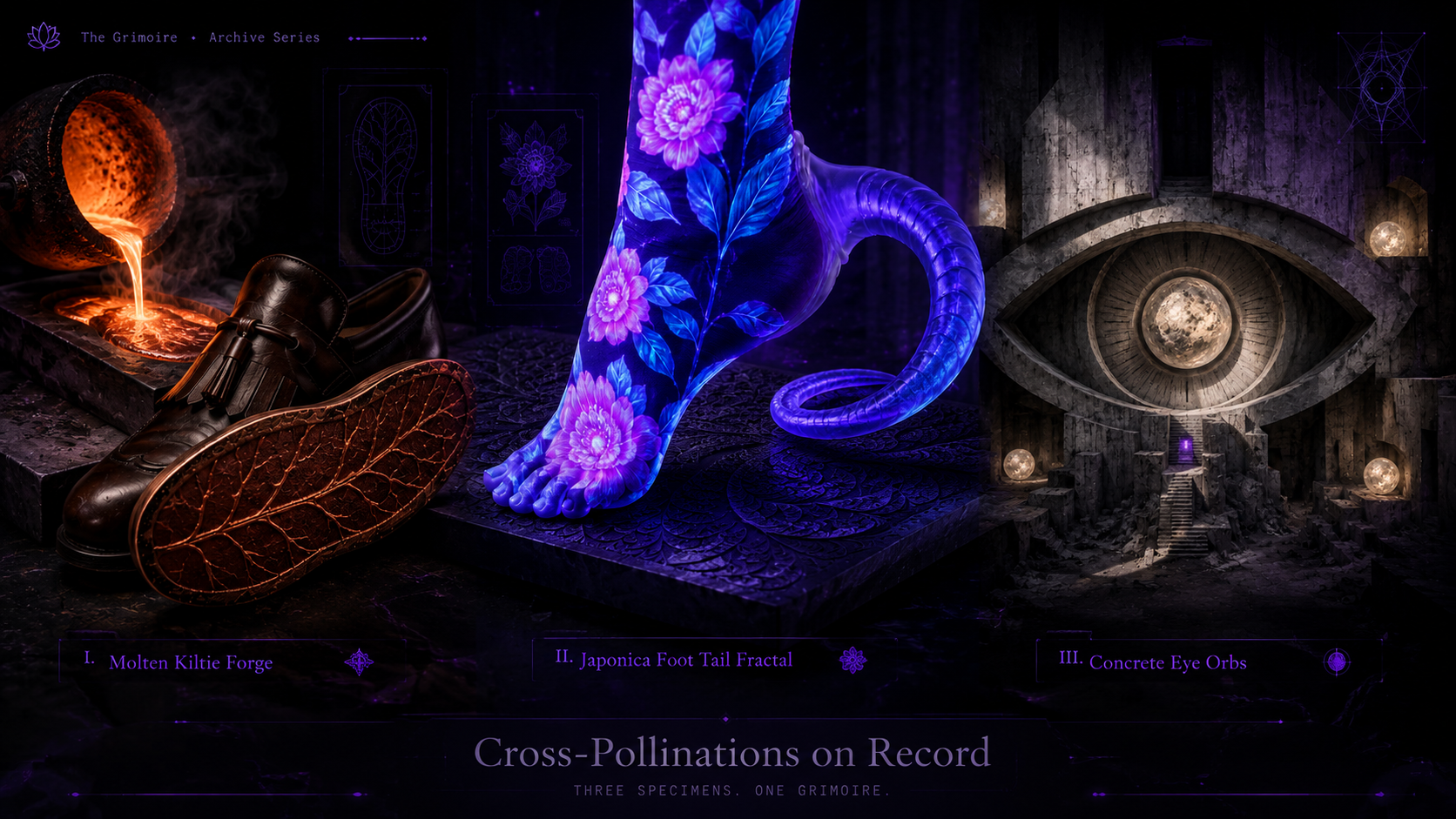
A recent Grimoire card fused smelting and kiltie loafers into a fictional copper-and-leather shoe artifact. As a fabrication recipe, it was false. As an image seed, it worked.
Another fused a floral foot covering, a tail prosthetic, UV glow, and fractal leaf geometry into a surreal fashion-specimen image.
Another turned concrete, glowing orbs, eye markings, and architectural mass into a quarry-cathedral eye.
Those are not paintings made of dots.
But the underlying logic is related.
Break the thing apart.
Name the parts.
Arrange the parts.
Let the image resolve.
Slop happens when the system averages everything into the most familiar mush.
Divisionism is useful because it is anti-mush.
It does not say, “Blend until everything is smooth.”
It says, “Keep the parts distinct enough that their relationship creates the image.”
That is a better model for creative systems.
A good image is not always a seamless blur of style. Sometimes it is a tense agreement between pieces that should not fully merge.
Copper and leather.
Foot and flower.
Concrete and eye.
Dot and light.
Pixel and face.
Concept and artifact.
The image works when the parts are structured well enough that the viewer, or the model, or the archive, can complete the jump.
Divisionism is easy to file away as a historical style.
Do not.
Treat it as an old workflow note from before screens took over the world.
It says that images do not have to be made by smoothing everything into one blended surface. They can be built from separated units, arranged with enough discipline that the eye creates the final image.
That is still useful.
Especially now.
The digital world did not invent the problem of resolution. It just gave us new materials for it.
Divisionism was already there, quietly saying:
Separate the signal.
Structure the surface.
Let the image resolve.